Issey Miyake understood fashion as something that should move with the body, not constrain it. His work transformed fabric into a kind of technology: responsive, lightweight and capable of changing shape as the wearer moved. Nowhere is this idea more beautifully realized than in PLEATS PLEASE ISSEY MIYAKE, the womenswear line that turned pleating into an entirely new language of dress.
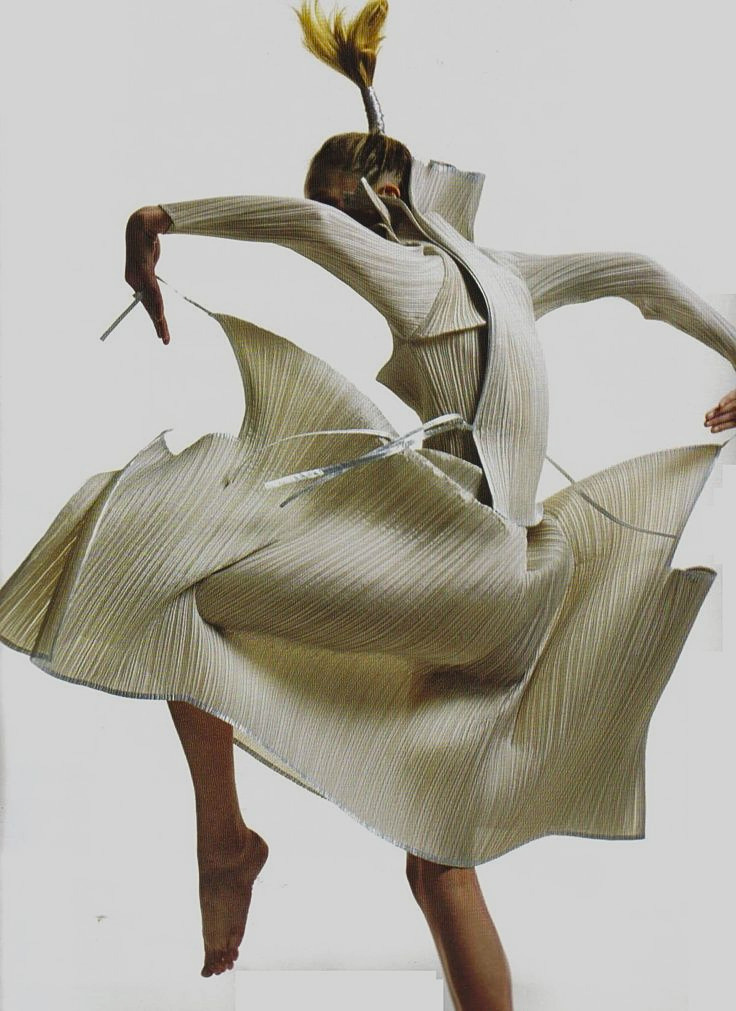
Issey Miyake, Frankfurt Ballet, 1993. Photo via Pinterest.
Issey Miyake
Issey Miyake approached fashion as an exploration of material, movement, and the relationship between clothing and the body. After studying graphic design in Tokyo and working in Paris, he returned to Japan and established the Miyake Design Studio in 1970.
His experiments with pleating began in the late 1980s and eventually became PLEATS PLEASE ISSEY MIYAKE. Garments were constructed larger than their final form, then folded, pressed, and heat-treated to create permanent pleats.
For Miyake, the technique was more than a visual signature. The pleats allowed clothing to expand and contract with the wearer, creating womenswear designed for movement rather than restriction.

Issey Miyake. Photo via W Magazine.
A New Language of Womenswear
PLEATS PLEASE launched as an independent brand in 1994, but its foundations were established through Miyake's earlier experiments with pleating. The clothes were lightweight, washable, durable, and adaptable, offering a practical alternative to the rigid construction that had traditionally defined womenswear. The significance was not simply that the clothes were comfortable. They changed the relationship between the garment and the woman wearing it.
A PLEATS PLEASE dress does not require the body to conform to a predetermined silhouette. The pleated surface creates its own space, allowing the garment to accommodate different bodies and movements. Walking changes the shape, sitting changes the shape, even turning changes the shape.

Issey Miyake Pleats Please long sleeve. Photo via Pinterest.
Pleating as Technology
The pleat became Miyake's technology of movement. A traditionally tailored garment depends on seams, darts, panels, and structured proportions. Miyake reduced that complexity by allowing the surface of the fabric to perform much of the work. The result looks simple because the engineering is hidden.
This is what makes PLEATS PLEASE feel closer to industrial design than conventional fashion. The pleat is simultaneously decorative and functional. It creates texture, controls volume, provides stretch, and allows the garment to recover its original form. For womenswear, this was particularly important. Fashion could remain sculptural without demanding that the woman remain still.

Pleats Please. Photo via Pinterest.
How Pleating Changed Fashion
Pleating changed more than the appearance of clothing. It challenged the assumption that womenswear needed to rely on structured silhouettes, delicate fabrics, or restrictive construction to create elegance. Instead, the technology of the textile could create the shape.
This idea influenced a broader understanding of fashion as functional technology. Stretch, recovery, lightweight construction, packability, and adaptability became qualities that could be celebrated rather than hidden. Miyake showed that technical innovation did not have to make clothing look futuristic. It could make everyday clothing work better.
His wider practice followed the same philosophy. The concept of A Piece of Cloth questioned the need to construct clothing from conventional patterns, while A-POC explored computer-controlled textile production. Even L'Eau d'Issey extended his interest in translating ideas of purity, material, and sensation into another medium.

Issey Miyake A-POC Runway, SS 1999. Photo via Pinterest.
The Walk Forward
PLEATS PLEASE remains powerful because its technology is inseparable from movement. The garment does not simply sit on the body; it responds to it.
Miyake created a form of womenswear in which comfort and experimentation were not opposites, and where engineering could become beautiful without announcing itself. His pleats transformed a simple surface into something kinetic, allowing fabric to expand, contract, and continuously change with the woman wearing it.
Fashion had always been concerned with how the body looked. Miyake made it equally concerned with how the body moves.